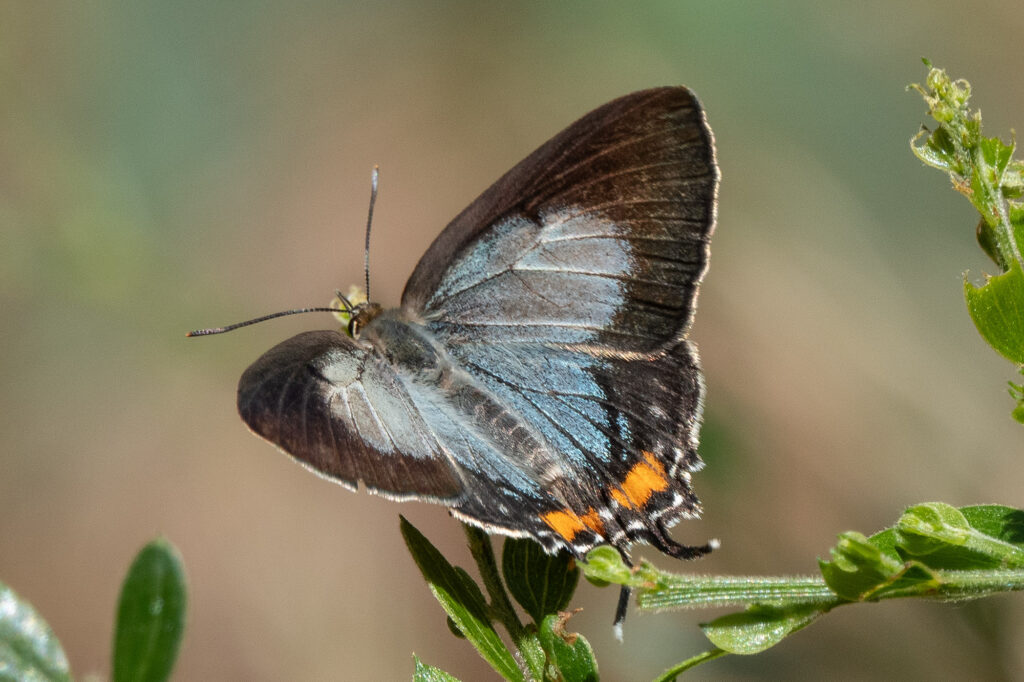
Imperial Hairstreak showing upper surface of wings.
Photos: Euan Moore.

Imperial Hairstreak, showing underside of wings.
Photos: Euan Moore.
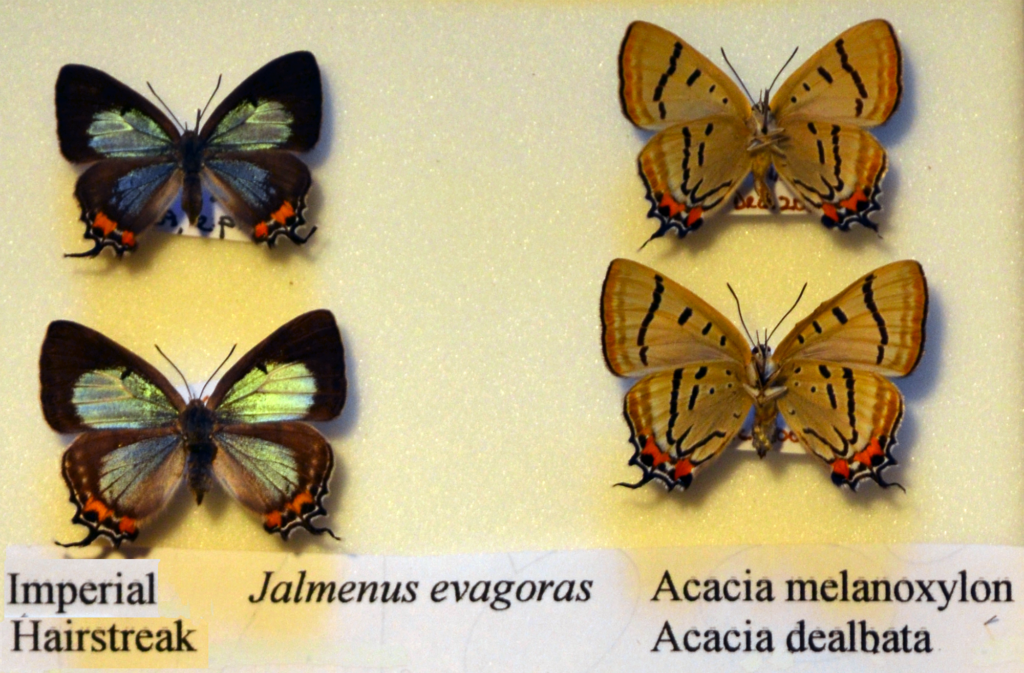
Museum specimens.
Photo: Tony Morton
Note 1: The male occurs on the top row and the female on the bottom row. The upper side of the butterfly wings are shown on the left and the underside side of the butterfly wings are shown on the right.
Note 2: The plant names refer to the plants upon which the butterfly larvae (caterpillars) feed.
Scientific Name: Jalmenus evagoras
Other Common Names: Common Imperial Blue, Pale Imperial Blue
Family of Butterflies: Lycaenidae (Blues and Coppers)
Wingspan: 32mm males, 37mm females
Local records: This species is relatively common in our region. There are records on iNaturalist and Atlas of Living Australia from Castlemaine Botanic Gardens, suburban Castlemaine, Fryers Ridge and Sebastopol Creek.
| Tony Morton’s records of Imperial Hairstreak from the local area (between 2000 to 2013) | ||
|---|---|---|
| Date | Location | Notes |
| 3-Dec-2011 | Vaughan Springs on recent planting on Left of road down to Springs | pupating on 4 spp of young Wattle (A. mearnsii, A.melanoxylon, A.acinacea, A.retinodes) |
| 24-Feb-2011 | Garden, Fryerstown | |
| 5-Dec-2009 | Vaughan walk | 11.30 – 1.30 p.m. Adult, a few pupae |
| 15-Nov-2009 | Botanic Gardens Castlemaine | 3 p.m. 33ºC larvae (top of tallish A. mearnsii along creek) |
| 27-Oct-2006 | Forest Creek | larvae on Wirilda |
| 18 – 25 Dec 2006 | Vaughan, Central Springs | fresh colonies |
| 3-Mar-2006 | Castlemaine | on Buddleia in Bot Gdn |
| 19-Feb-2006 | Chewton area | on Wirilda!! Forest Creek. Also on A. dealbata and A.mearnsii, but to lesser extent. Small colony. |
| 6-Feb-2006 | Glen Luce springs | fresh female |
| 5-Dec-2005 | Castlemaine | along creek in Bot Gdn on small wattles. LPI |
| Dec. 2002 | Brown’s house, Old Drummond Road, Taradale | on regrowth A. mearnsii |
| 8-Jan-2002 | Chewton area | 1 v. small on walk to Welsh Town. THE ONLY ONE SEEN THIS SUMMER |
| 2001 – 2002 | Central Vic., Vaughan | only one small male seen near Chewton during the year. |
| 16-Jan-2001 | Green Gully Rd. walk (creek) | larvae, imagines |
| 3-Dec-2000 | Bluff, Central Springs, Vaughan | |
| 29-Nov-2000 | Central Springs, Vaughan | L,P,I, several colonies on small A. melanoxylon |
| 27-Nov-2000 | 100m. below Tarilta Road bridge, Vaughan | L, P. on young A. melanoxylon, pupae brownish |
| 22-Nov-2000 | Vaughan Springs | L,P. On young A. dealbata. Pupae black |
Distribution outside our region: Castlemaine is at the north-western limit of distribution for this species in Victoria. Most documented Victorian observations of this species are in eastern half of state, although also records from the Daylesford – Lerderderg area. Outside victoria this species is found along the east coast of Australia to as far north as Rockhampton, Qld. ref. iNaturalist and Atlas of Living Australia.
Larval Host Plants: A variety of acacias, particularly Late Black Wattle (Acacia mearnsii), Early Black Wattle (A. decurrens), Silver Wattle (A. dealbata) and Blackwood (A. melanoxylon) but may also use other Acacia spp.
Larval association with ants: Iridomyrmex spp.
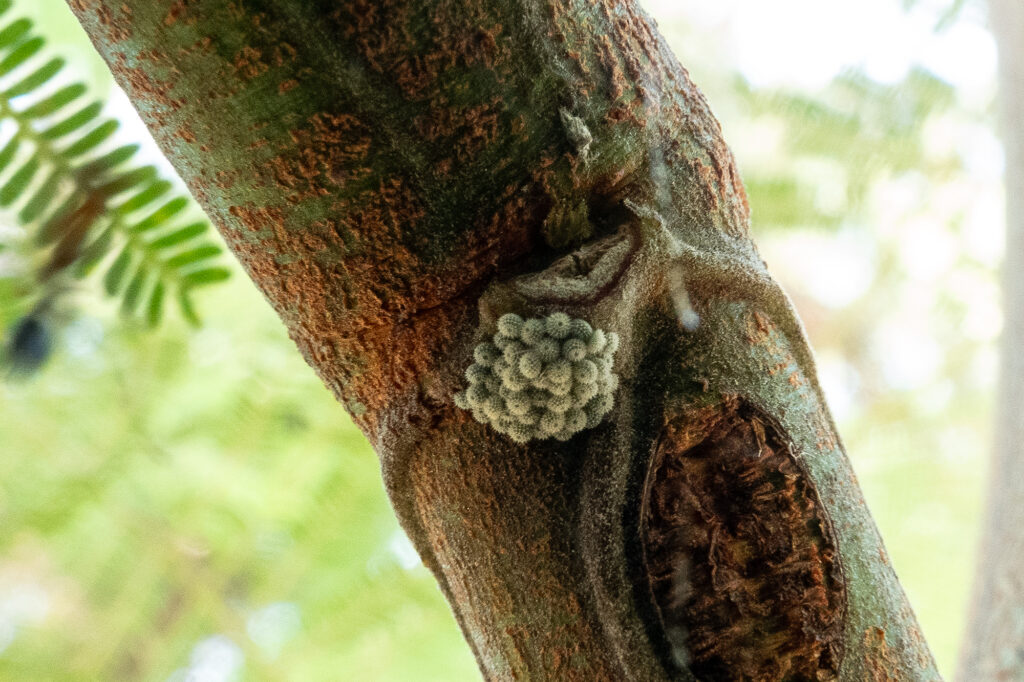
Eggs are laid in clusters against the trunk on the underside of a branch or node.
Photo: Euan Moore

Larva on a blackwood, Acacia melanoxylon, stem. It is being attended by Iridomyrmex sp. ants. Note the presence, also, of plant-hopper nymphs.
Photo: Euan Moore

Pupae on blackwood. They are generally found in clusters amongst the leaves on small branches. They continue to receive attention from the ants.
Photo: Euan Moore

When the adults emerge from the pupa, males will cluster around waiting for an opportunity to mate with the newly emerged females.
Photo: Euan Moore
Adult Flight Times in Victoria: In Victoria, there is a peak of observations from December to March, but some observations from November to April.
Conservation Status:
- The Action plan for Australian Butterflies: No Conservation Significance
Other Notes: Mount Alexander Shire is at the edge of the species known distribution (Field 2013). It was regularly documented by Tony Morton and may be becoming more common in our area. Colonies of butterflies appear to be faithful to their food plant and ants over multiple years.
It is often documented in disturbed areas where wattle host plants are regenerating (Field 2013).
References and further reading:
Atlas of Living Australia – Jalmenus evagoras, Imperial Hairstreak.
iNaturalist – Jalmenus evagoras, Imperial Hairstreak
Braby, Michael F., Second edition 2016. The Complete Field Guide to Butterflies of Australia. CSIRO Publishing.
Field, Ross P., 2013. Butterflies: Identification and Life History. Museum Victoria