
Fringed Heath-blue, upper surface, on Common Wedge-pea, Porcupine Ridge.
Photo: Euan Moore

Fringed Heath-blue, under surface. The two black ‘V‘ shaped marks on the hind wing are diagnostic.
Photo: Euan Moore
Scientific Name: Neolucia agricola subsp agricola
Other Common Names: Fringed Blue
Family of Butterflies: Lycaenidae (Blues and Coppers)
Wingspan: 20mm
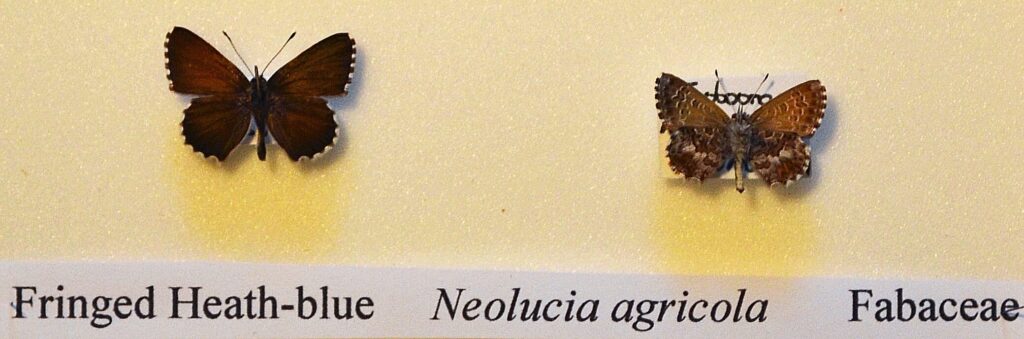
Museum specimens.
The plant name refers to the plant family upon which the butterfly larvae (caterpillars) feed.
Photo: Tony Morton
Local Observations: Atlas of Living Australia has a museum record from Castlemaine from October 1907 and numerous other records from our region. On iNaturalist there are recent records from sites around Castlemaine, Muckleford Conservation Reserve, Porcupine Ridge and Glen Lyon.
| Tony Morton’s records of Fringed Heath-blue from the local area (2000 to 2013) | ||
|---|---|---|
| Date | Location | Notes |
| 31-Oct-2012 | Kalimna Point | |
| 18-Nov-2011 | Kalimna Point | |
| 15-Nov-2011 | The Monk, Chewton | |
| 14-Oct-2011 | Kalimna ridge | |
| 11-Nov-2009 | Kalimna Park | 10 a.m. – 1 p.m. 34ºC |
| 28-Oct-2008 | Jacob’s Track | |
| 1-Nov-2006 | The Monk, Chewton | |
| 1-Nov-2006 | Kalimna Point | |
| 11-Oct-2006 | Kalimna ridge | |
| 16-Nov-2004 | Kalimna Park | |
| 7-Nov-2003 | Kalimna Park | |
| 28-Nov-2002 | Kalimna Point | |
| 21-Nov-2002 | Kalimna ridge | |
Distribution outside our region: Atlas of Living Australia and iNaturalist have records from most of Victoria, south-east South Australia, eastern NSW and south-east Queensland. Other sub-species occur in Tasmania and WA.
Larval Host Plants: Variety of native peas from the family Fabacae, including Bossiaea spp., Gorse Bitter-pea Daviesia ulicifolia, Showy Parrot-pea D. sericea, Twiggy Bush-pea Pultenaea largiflorens and Narrow-leaf Bush-pea P. tenuifolia.
Larval association with ants: Larvae often associated with small ants from the Iridomyrmex genus.
Adult Flight Times in Victoria: One generation is completed each year, with most adults observed in Victoria between October to December (but some seen through until March).
Conservation Status:
- The Action plan for Australian Butterflies: No Conservation Significance
Other Notes: Moderately common in heathy woodland and forest habitats in the Mount
Alexander region.
References and further reading:
Atlas of Living Australia – Neolucia agricola agricola, Fringed Heath-blue
iNaturalist – Neolucia agricola, Fringed Heath-blue
Braby, Michael F., Second edition 2016. The Complete Field Guide to Butterflies of Australia. CSIRO Publishing.
Field, Ross P., 2013. Butterflies: Identification and Life History. Museum Victoria