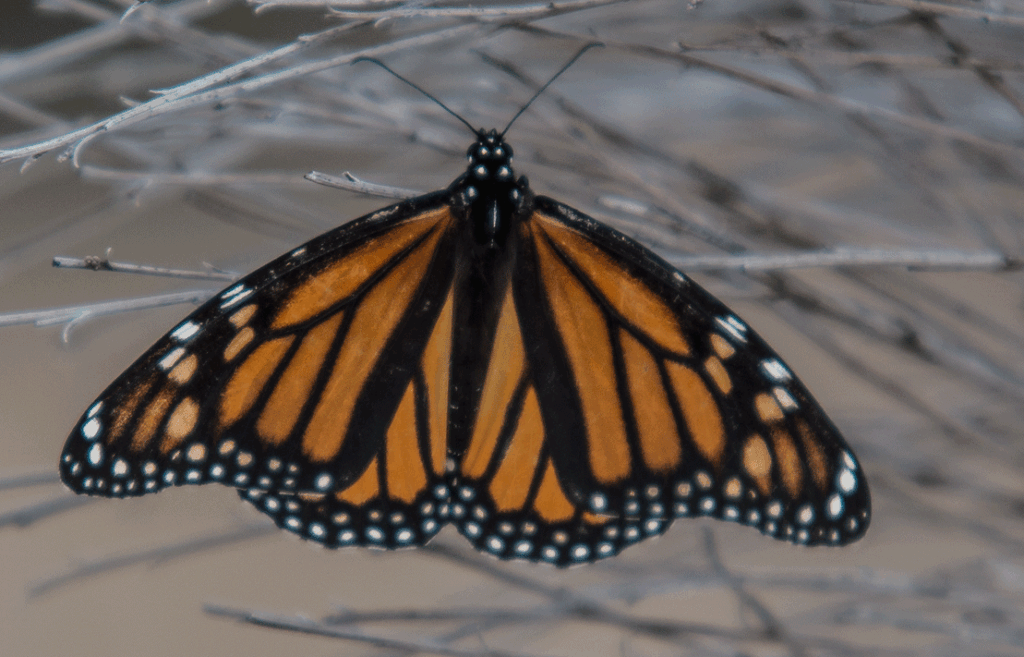
Monarch, upper surface.
Photo: Euan Moore,

Monarch, lower surface.
Photo: Cathrine Harboe-Ree.
Scientific Name: Danaus plexippus
Other Common Names: Wanderer, Milkweed Butterfly
Family of Butterflies: Nymphalidae (Browns and Nymphs)
Wingspan: 93mm
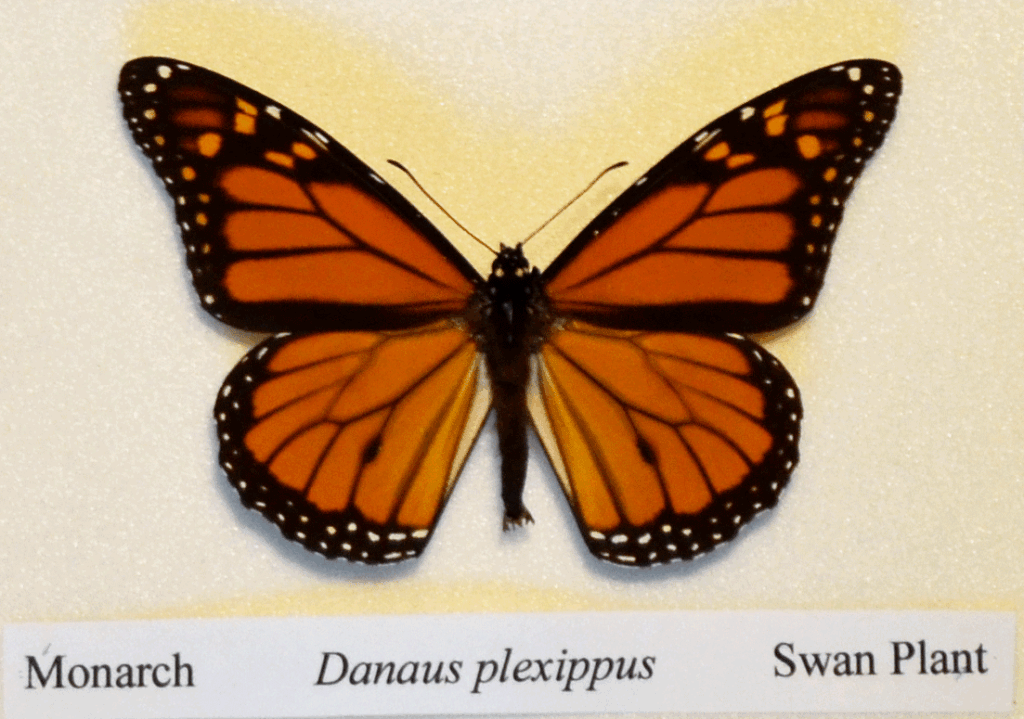
Museum specimen. Photo: Tony Morton.
Note 1: The upper side of the butterfly wings are shown. Males and females are similar.
Note 2: The plant name on the bottom right refers to the plants upon which the butterfly larvae (caterpillars) feed.
Local observations: There are several records on iNaturalist and Atlas of Living Australia from the Castlemaine area with others from Bendigo, Kyneton and Clunes. Most of these records are from urban areas where the main food plants are often grown in gardens.
| Tony Morton’s records of Monarch from the local area between 2000 to 2013 | ||
|---|---|---|
| Date | Location | Notes |
| 24-Feb-2006 | near old Gaol. 1 seen | |
| 27-Mar-2000 | Park, Castlemaine | |
Distribution outside our region: This is an introduced species first documented in Australia (Queensland) in 1871, and later the same year near Melbourne. It is now found across most of Victoria and all other Australian states (Atlas of Living Australia). Most records are from the more populated areas. Monarchs are native to North and Central America where they are widespread. They have also been introduced to NZ and many Pacific Islands, Spain and North Atlantic Islands (iNaturalist).
Larval Host Plants: Introduced plants including
Swan Plant (Gomphocarpus fruticosus). This plant
may be found in some parks and gardens within
shire. Caterpillars feed in the open. There is little
predation upon larvae by birds, because of toxins
ingested from the Swan Plant.
Larval association with ants: None.

Monarch caterpillar on Swan Plant, Gomphocarpus fruticosus, near the old prison, Castlemaine. Photo: Euan Moore
Adult Flight Times in Victoria: Adults have been recorded throughout the year in Victoria, but never common (compared to northern Australia). No permanent population in Victoria, but recolonise annually. Some successful breeding does occur on cultivated plants. Most commonly observed between January to April.
Conservation Status:
- The Action plan for Australian Butterflies: No Conservation Significance
- Flora and Fauna Guarantee Act 1988 – Threatened List: Not Listed
Other Notes: Within its native range of North America this species is famous for its migrations and
overwintering flocks. Migratory behavior and overwintering flocks have been recorded in the
introduced population in NZ and there are reports of flocking behavior during winter months in Victoria
(Observations, Castlemaine Naturalist, June 2021).
References and further reading:
Atlas of Living Australia – Danaus plexippus, Monarch.
iNaturalist – Danaus plexippus, Monarch.
Braby, Michael F., Second edition 2016. The Complete Field Guide to Butterflies of Australia. CSIRO Publishing.
Field, Ross P., 2013. Butterflies: Identification and Life History. Museum Victoria.