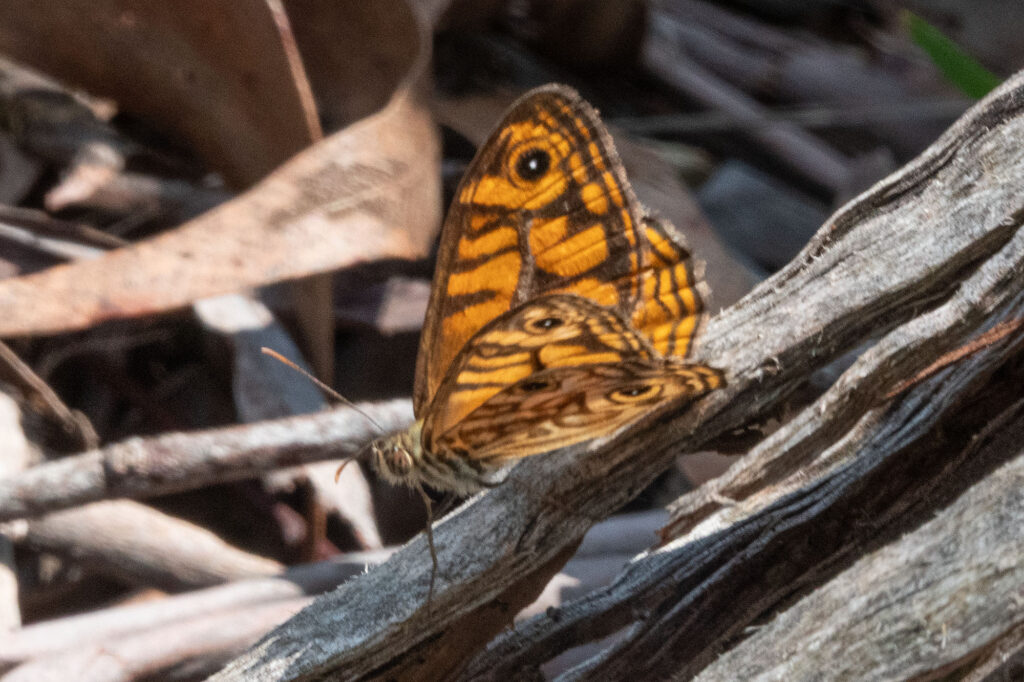
Ringed Xenica, upper. Photo: Euan Moore.
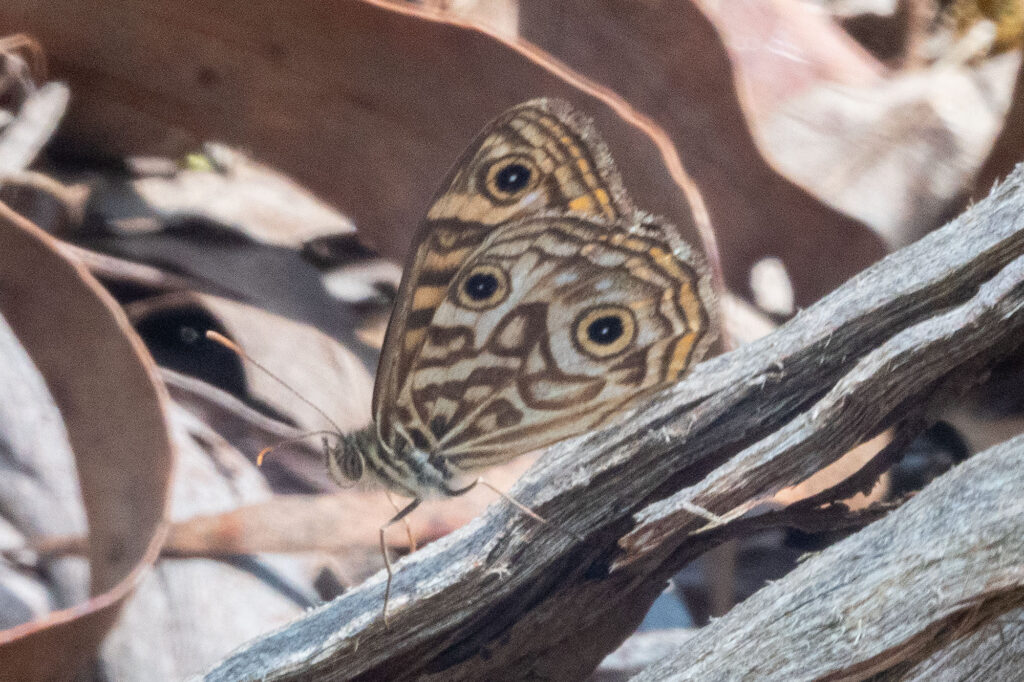
Ringed Xenica, lower. Photo: Euan Moore.
Scientific Name: Geitoneura acantha
Family of Butterflies: Nymphalidae (Browns and Nymphs).
Other Common Names: Eastern Ringed Xenica, Southern Ringed Xenica.
Wingspan: 39mm male, 44mm female.
Local observations: There are records of this species on Atlas of Living Australia from Barringhup and
Glenlyon. More recent records on iNaturalist are from the Taradale – Glenlyon area south-east of Castlemaine. Our region is at the northern/inland limit for this species in Victoria.
| Tony Morton’s documented records of Ringed Xenica from the local area (between 2000 to 2013). | ||
|---|---|---|
| Date | Location | Notes |
| 6-Feb-2006 | Glen Luce springs | river very dry |
| 26-Dec-2005 | Glen Luce springs | one only |
| 23-Feb-2001 | Gully, Chewton/Fryerstown Road | female |
| 16-Jan-2001 | Green Gully Rd. walk | |
| 29-Feb-2000 | Vaughan walk | |
Distribution outside our region: In Victoria this species is found in southern and eastern areas. Outside
Victoria this species is found in the Adelaide Hills, eastern NSW and south-eastern Queensland. Ref: Atlas of Living Australia
Larval Host Plants: Grasses such as Weeping grass (Microlaena stipoides) and Poa sieberiana.
Larval association with ants: None.
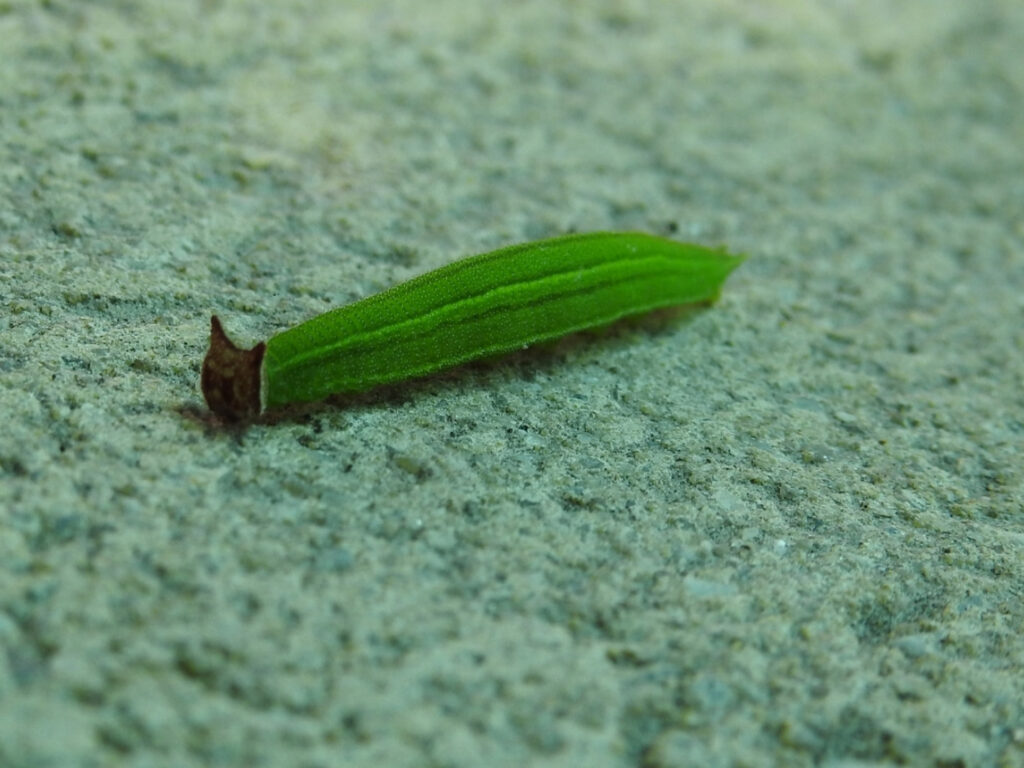
Ringed Xenica larva.
Photo: Melanie Chi-ong / iNaturalist
Adult Flight Times in Victoria: Adults have been recorded from November to May, and most commonly
from January to March.
Conservation Status:
- The Action Plan for Australian Butterflies: No Conservation Significance
Other Notes: There is one generation per year, with larvae overwintering. It is common in moist shady
gullies and wet eucalypt forests.
References and further reading:
Atlas of Living Australia – Geitoneura acantha, Ringed Xenica
iNaturalist – Geitoneura acantha, Ringed Xenica
Braby, Michael F., Second edition 2016. The Complete Field Guide to Butterflies of Australia. CSIRO Publishing.
Field, Ross P., 2013. Butterflies: Identification and Life History. Museum Victoria.