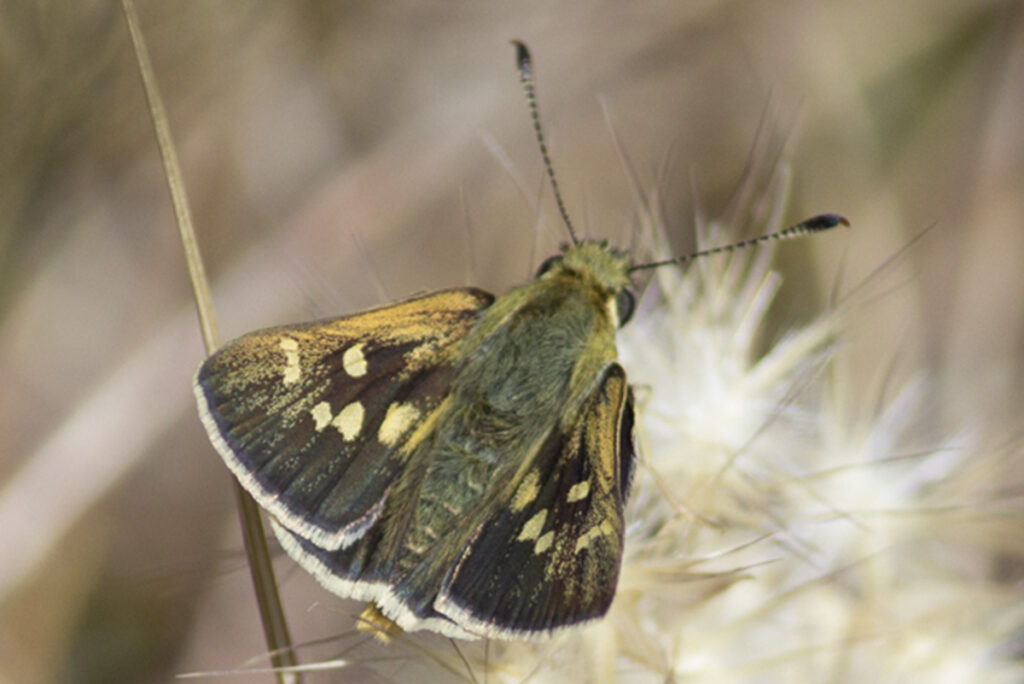
Yellow Ochre, Trapezites luteus ssp. leucon, from Barringhup showing the upper wing.
Photo: Kerrie Jennings
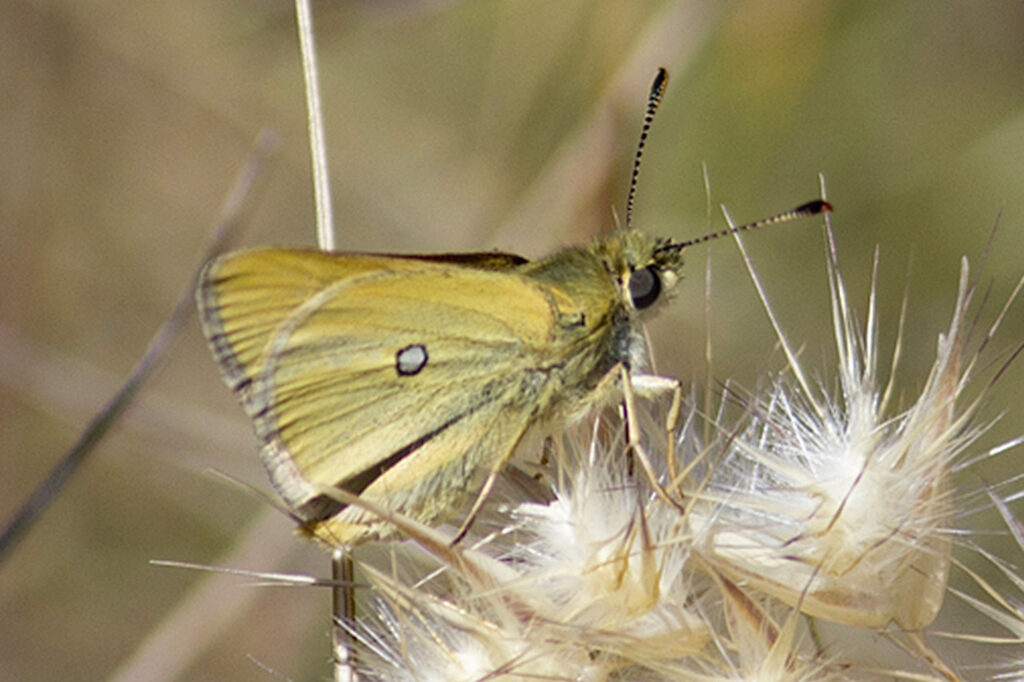
Yellow Ochre, showing the lower wing with the single diagnostic white spot on the hind wing.
Photo: Kerrie Jennings
Scientific Name: Trapezites luteus ssp. leucon
Family of Butterflies: Hesperiidae (skippers)
Other Common Names: Rare White-spot Skipper
Wingspan: 27mm (Male), 31mm (female)
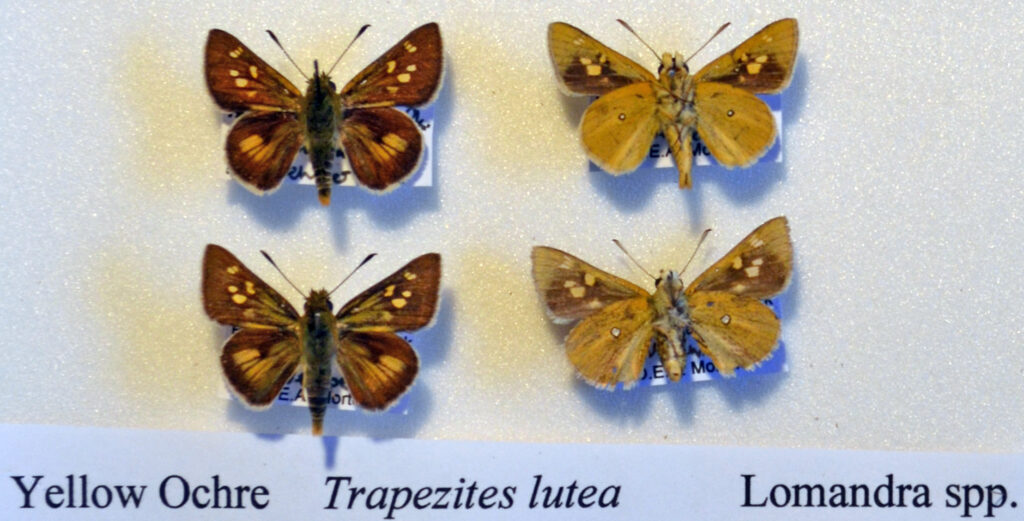
Museum specimens. Photo: Tony Morton
Note 1: The male occurs on the top row and the female on the bottom row. The upper side of the butterfly wings are shown on the left and the underside side of the butterfly wings are shown on the right.
Note 2: The plant name refers to the plant upon which the butterfly larvae (caterpillars) feed.
Local Records: There are few local records for this species. Atlas of Living Australia has a single museum record from Castlemaine collected 1988 while the next closest record is from Creswick. There is a recent record on iNaturalist from Maldon along with other records from Castlemaine and Taradale. There is another recent record from Barringup in 2021. Tony Morton recorded this species in Kalimna Park, Castlemaine on several occasions as well as in the Fryerstown area.
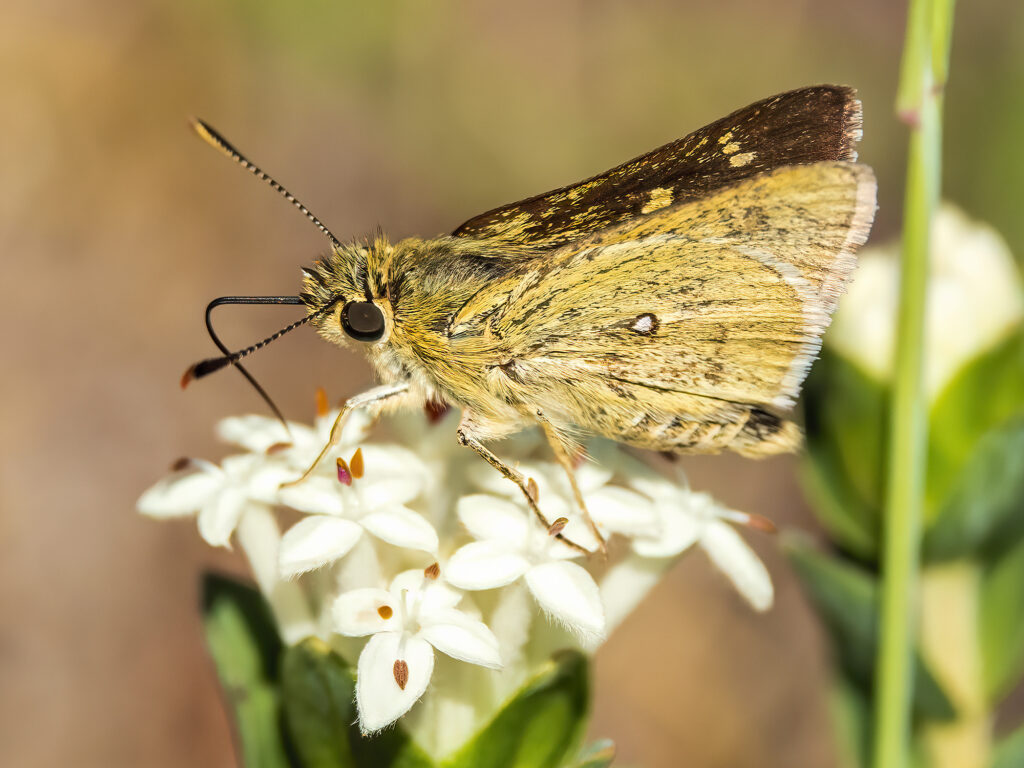
Yellow Ochre from Maldon.
Photo: Albert Wright. 2020.
| Tony Morton’s records of Yellow Ochre from the local area (between 2000 to 2013) | ||
|---|---|---|
| Date | Location | Notes |
| 8-Nov-2000 | Rotunda, Kalimna Park | |
| 14-Nov-2000 | Rotunda, Kalimna Park | |
| 25-Nov-2000 | Rotunda, Kalimna Park | |
| 26-Nov-2003 | Kalimna Park, Castlemaine, Vic. | Female, fresh |
| 16-Nov-2004 | Kalimna Park, Castlemaine, Vic. | |
| 17-Oct-2005 | Kalimna Point | |
| 11-Nov-2009 | Kalimna Park | 10 a.m. – 1 p.m. 34ºC |
| 14-Oct-2011 | Kalimna Point | |
| 11-Sep-2012 | Kalimna Park | |
| 30-Oct-2012 | Garden, Fryerstown | 2 males |
| 24-Nov-2012 | Garden, Fryerstown | |
Distribution outside our region: Most documented Victorian observations of this species shown in Atlas of Living Australia are from Ballarat through to Macedon and from the Latrobe Valley. Outside Victoria there are concentrations of records from the Canberra area and eastern Tasmania.
Larval Host Plants: Mat Rushes (Lomandra filiformis and Lomandra longifolia).
Larval association with ants: None
Adult Flight Times in Victoria: Two peaks each year (October to December and February to April), although it is thought that adults emerging in autumn are from larvae more than 10 months old. That is, eggs laid during the first peak are unlikely to have completed their life cycle in time for the second peak.
Conservation Status:
- The Action plan for Australian Butterflies: Vulnerable in Australia
References:
Atlas of Living Australia – Trapezites luteus, Yellow Ochre
iNaturalist Australia – Trapezites luteus, Yellow Ochre
Braby, Michael F., Second edition 2016. The Complete Field Guide to Butterflies of Australia. CSIRO Publishing.
Field, Ross P., 2013. Butterflies: Identification and Life History. Museum Victoria.