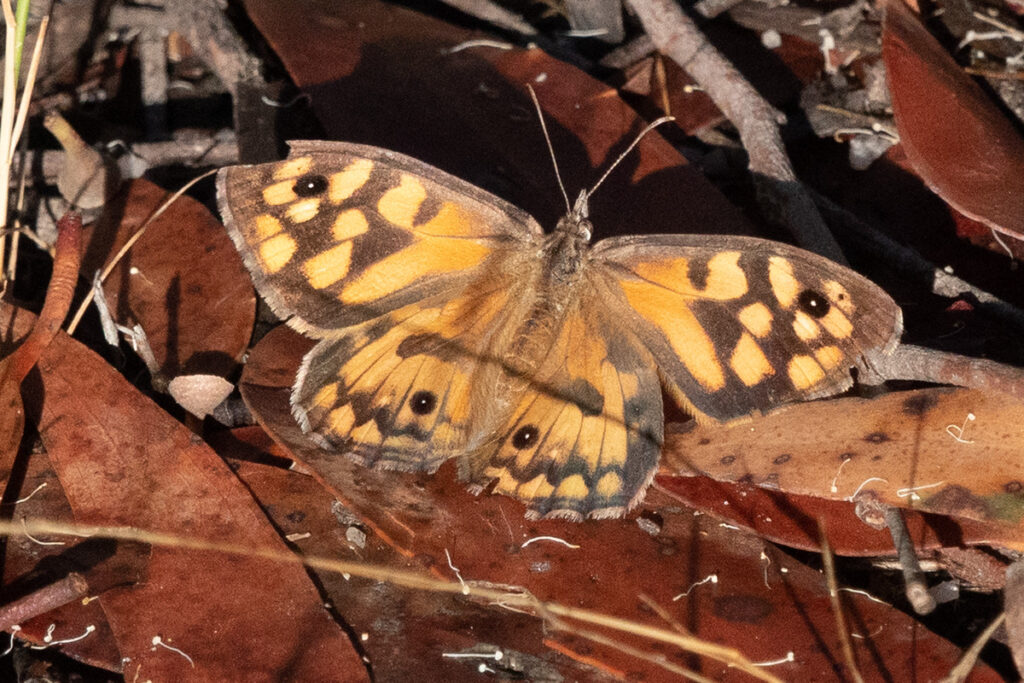
Marbled Xenica, showing upper wing. Photo: Euan Moore
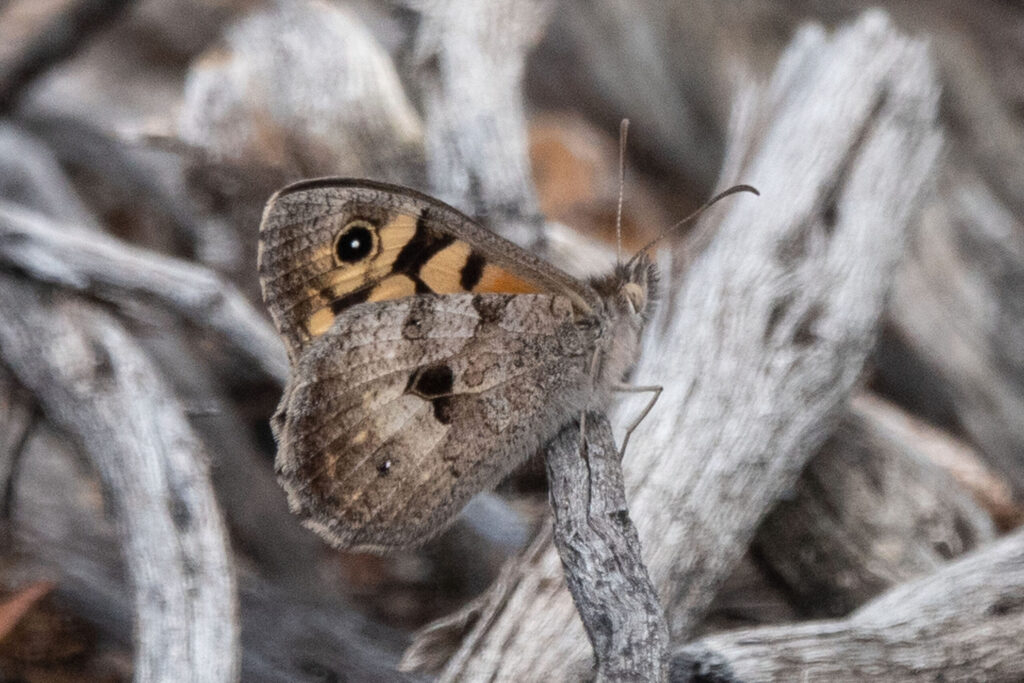
Marbled Xenica, showing lower wing. The dark patch in the center of the underside of the hindwing is a useful diagnostic feature. Photo: Euan Moore
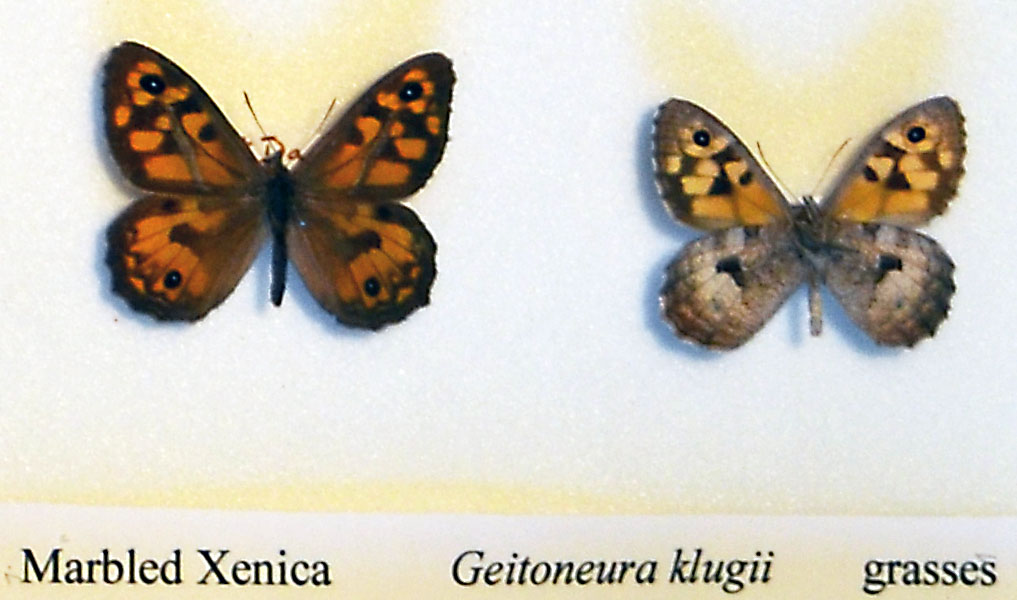
Museum specimens. Photo: Tony Morton
Note 1: Both are female. The upper side of the butterfly wings is shown on the left and the underside
side on the right. Males and females are similar, but females are paler above.
Note 2: The plant name at the bottom right refers to the plants upon which the butterfly larvae (caterpillars) feed.
Scientific Name: Geitoneura klugii
Family of Butterflies: Nymphalidae (Browns and Nymphs)
Other Common Names: Klug’s Xenica
Wingspan: 39mm males, 42mm females.
Local observations: Castlemaine is near the northern edge of the species range in central Victoria. Most records in the Mount Alexander region are to the south of Castlemaine although this species is common in Kalimna Park. Both iNaturalist and Atlas of Living Australia have many records from near Lyonville.
| Tony Morton’s documented records of Marbled Xenica from the local area (between 2000 to 2013) | ||
|---|---|---|
| Date | Location | Notes |
| 1-Jan-2013 | Kalimna Park | fresh, several |
| 15-Jan-2011 | Bot Gardens, off Froomes Road, C’maine | |
| 19-Dec-2005 | Kalimna Park | |
| 16-Jan-2001 | Green Gully Rd. walk | |
| 10-Jan-2001 | Rotunda & Ridge, Kalimna Park | |
| 29-Feb-2000 | Vaughan walk | |
Distribution outside our region: In Victoria this species is found in all areas except the northern plains
and the north-west mallee country. This widespread species occurs across southern Australia and
Tasmania from north of Perth to Brisbane. Most records are within 200km of the coast.
Larval Host Plants: Native grasses such as Wallaby Grass (Austrodanthonia spp.), Kangaroo Grass, Themeda triandra and some tussock grasses, Poa spp. Introduced grasses such as Annual Veldt Grass,
Erhardta longiflora and Fescue, Vulpia spp.
Larval association with ants: None.
Adult Flight Times in Victoria: Adults have been recorded from October to April, and most commonly
from December to February. One generation per year.
Conservation Status:
- The Action Plan for Australian Butterflies: No Consevation Significance
Other Notes: This species is known to hilltop. Males will defend their areas against other males. It
occurs in a variety of woodland and forest habitats where there is an adequate grassy understorey.
References and further reading:
Atlas of Living Australia – Geitoneura klugii, Klug’s Xenica.
iNaturalist – Geitoneura klugii, Klug’s Xenica
Braby, Michael F., Second edition 2016. The Complete Field Guide to Butterflies of Australia. CSIRO Publishing.
Field, Ross P., 2013. Butterflies: Identification and Life History. Museum Victoria.