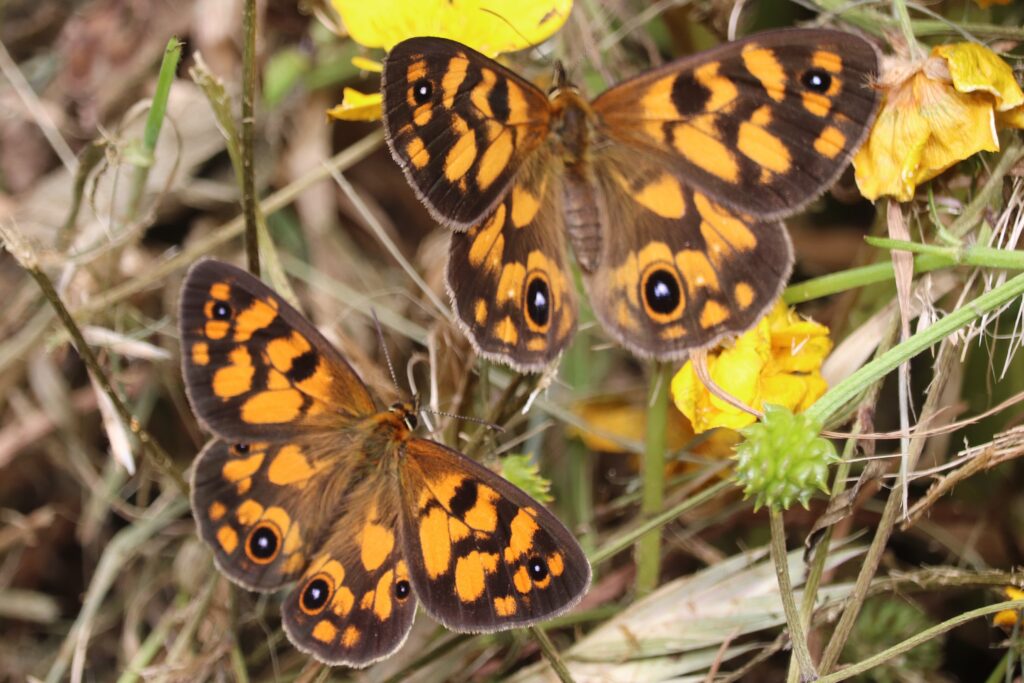
Bright-eyed Brown, Female (top) and Male (below)
Photo: Hepburn Shire Council / iNaturalist.
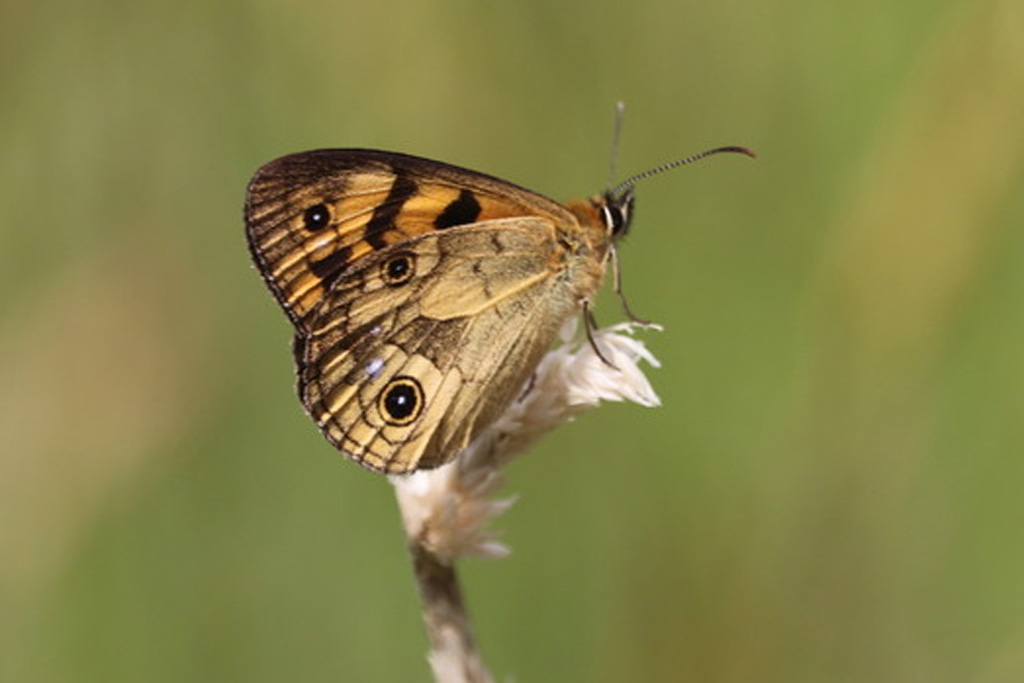
Bright-eyed Brown, Male, underside
Photo: Hepburn Shire Council / iNaturalist.
Scientific Name: Heteronympha cordace cordace
Other Common Names: None
Family of Butterflies: Nymphalidae (Browns and Nymphs)
Wingspan: males 38mm, females 42mm
Local Records: Prior to the 2022-23 summer the only records in our region were from Trentham in 1916. Over the 2022/23 summer there were six reports on the iNaturalist website from near Trentham with additional reports in subsequent years. As to be expected with a cooler climate species all records were from the south of the region, around Daylesford, Lyonville and Trentham.
Distribution outside our region: This species occurs mainly in wetter areas. Records in Atlas of Living Australia and iNaturalist stretch along the ranges from Mt Cole in the west to the NSW border and north to Coffs Harbour with other records to the east of Melbourne and in the Strzelecki Range. It is also found in Tasmania. Most recent records are east of Melbourne. West of Melbourne records are almost all pre-1970 or since 2023. In south-west Victoria and possibly the Grampians there are a few records of a second subspecies, H. c. wilsoni.
Larval Host Plants: Tall Sedge, Carex appressa.
Larval association with ants: None
Adult Flight Times in Victoria: From November through March, peaking in January.
Conservation Status:
- National Butterfly Action Plan (2002): H. c. cordace: Not listed. H. c. wilsoni: Critically Endangered.
- Victorian Flora and Fauna Guarantee Act – Threatened List: H. c. cordace: Not listed. H. c. wilsoni: Critically Endangered.
Other Notes: Four of the locations where this species has been found in our region have been subjected to blackberry and willow control in preceding years which has allowed recolonization of Tall Sedge, Carex appressa, the main larval food plant. Open conditions that have favoured summer-flowering nectar
plants – in particular the introduced Creeping Buttercup, Ranunculus repens, and Birds-foot Trefoil, Lotus corniculatus. At Trent Creek, plantings of Prickly Tea Tree, Leptospermum juniperinum, reintroduced one of the known native food plants and these were being used by the Bright-eyed Browns in January 2021 (not formally reported until 2023). The species makes a good flagship for weed control in wetland areas. It is the emblem for the 2023 Chillout festival as the Lake Daylesford site has been adopted by the festival as an ongoing community planting site.
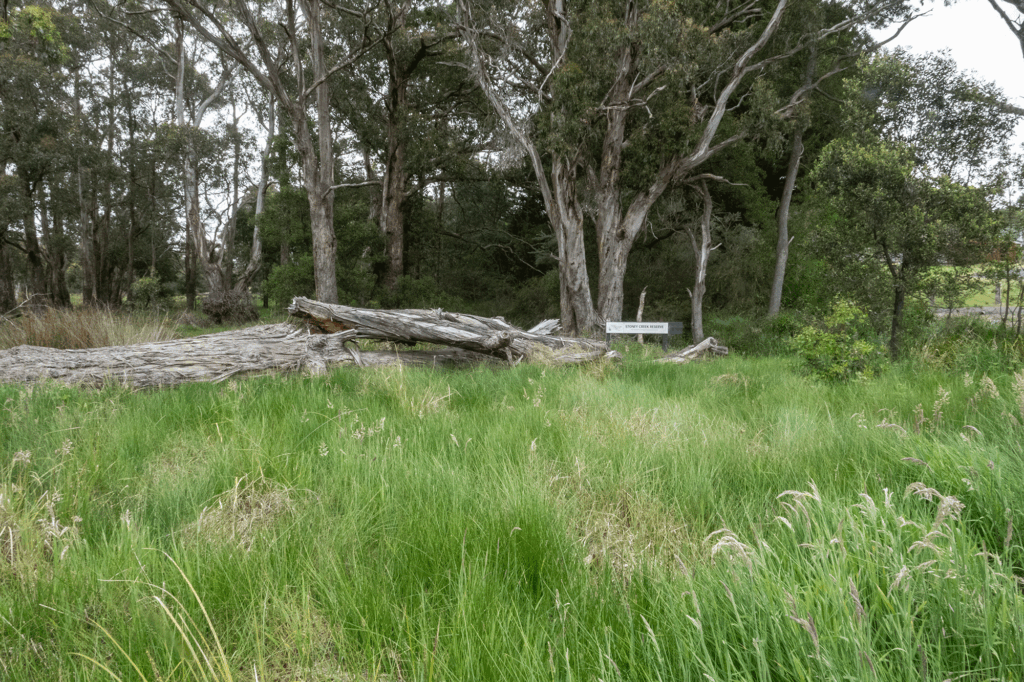
Restored wetland with dense Tall Sedge provides butterfly habitat along Stony Creek at Trentham.
Photo: Euan Moore
References:
Atlas of Living Australia – Heteronympha cordace, Bright-eyed Brown.
iNaturalist Australia – Heteronympha cordace, Bright-eyed Brown.
Braby, Michael F., Second edition 2016. The Complete Field Guide to Butterflies of Australia. CSIRO Publishing.
Field, Ross P., 2013. Butterflies: Identification and Life History. Museum Victoria.