
Imperial Jezebel, Delias harpalyce, male, Barkers Creek, Castlemaine.
Photo: Mez Woodward
Scientific Name: Delias harpalyce
Family of Butterflies: Pieridae (Whites and Yellows)
Other Common Names: Imperial White
Wingspan: 67 mm, male. 72 mm, female
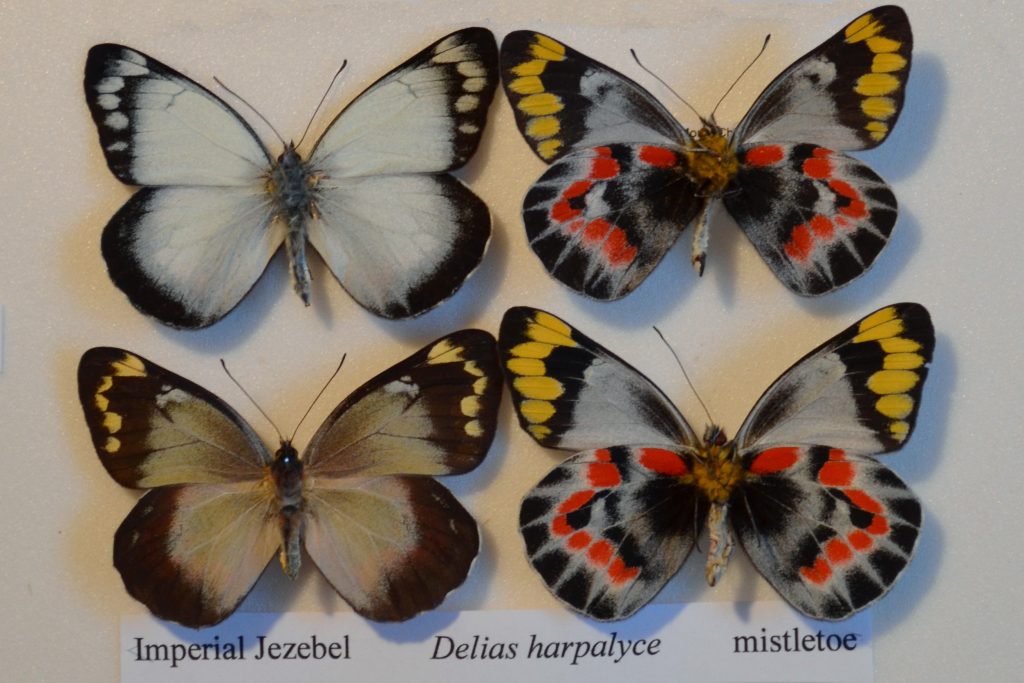
Imperial Jezebel, Upper wings left, lower wings right. Male (above) and Female (below).
Museum specimens. Photo: Tony Morton.
Local Records: Prior to 2022 there were only a few records close to the Mt Alexander region on Atlas of Living Australia. Apart from a single record near Bendigo the closest official records were from places that are at higher altitude on the Great Dividing Range such as near Kyneton and at Wombat Forest where there is a cooler wetter climate. Although there are few earlier reports, there have been frequent sightings from across our region logged on iNaturalist over the 2021/2022, 2022/2023 and 2023/2024 summers.
During the 2022/2023 summer breeding was recorded at Barkers Ck. The caterpillars feed on Box Mistletoe. The cocoons are attached to a mistletoe leaf.
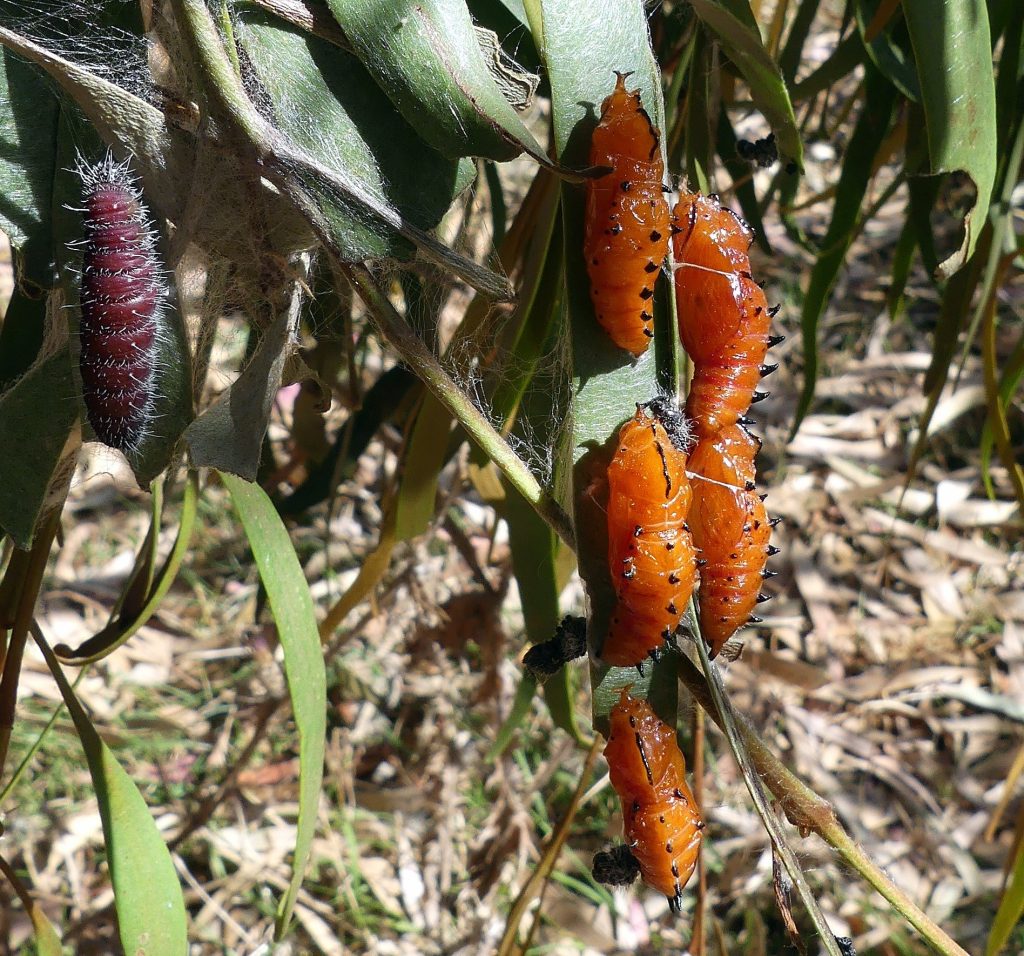
Caterpillar (far left) and cocoons on Box Mistletoe, Barkers Ck, Castlemaine. The cocoons will turn black as they age.
Photo: Mez Woodward
Larval Host Plants: Mistletoes of the genus Amyema.
Distribution: This is a mainly coastal species found from south-east Queensland to the Otway Ranges with most records on the crest of or east of the Great Dividing Range.
Adult Flight Times in Victoria: Peak activity is in spring (September-October) with a second peak in late summer (January-February) although small numbers may be seen during the rest of the year. Across Australia, overall flight times are similar with the main peak in activity being late summer into autumn. Ref iNaturalist.
Conservation Status:
- The Action plan for Australian Butterflies: No Conservation Significance
- Flora and Fauna Guarantee Act 1988 – Threatened List 2021: Not Listed
Other Notes: Adults often soar in the tree tops, particularly during sunny mornings when temperatures
are lower. Activity ceases if the temperature becomes too high.
This butterfly is somewhat similar to the Red-spotted Jezebel but is much darker with almost no white on the underside of the wings. The upper wings of the female are black and grey compared to black and white in the male. Images can be seen above and on iNaturalist.
References and further reading:
Atlas of Living Australia – Delias harpalyce, Imperial Jezebel
iNaturalist – Delias harpalyce, Imperial Jezebel.
Braby, Michael F., Second edition 2016. The Complete Field Guide to Butterflies of Australia. CSIRO Publishing
Field, Ross P., 2013. Butterflies: Identification and Life History. Museum Victoria